
Pool Chlorine Calculator
Enter your pool volume, current free chlorine (FC) and the level you want, then choose your chlorine product. The calculator tells you how much to add, how much stabiliser (CYA) the product adds, and a target range based on your CYA level.
- Free to use
- No sign-up
- Runs in your browser
Calculate chlorine to add
Pool Care Log & Dosing Workbook
A season-long pool log with automatic dosing for chlorine, pH and alkalinity, plus printable test logs and a start-up checklist.
- Pool dosing & log workbook (XLSX, PDF)
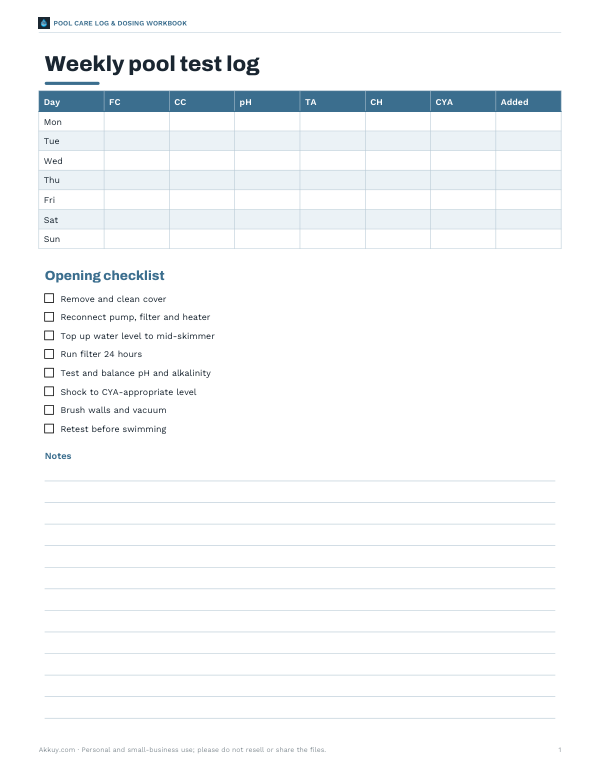
- Weekly test log & opening checklist (PDF, DOCX)
Formats: XLSX, PDF, DOCX. Instant download after payment (link valid 72 hours, up to 5 downloads). AI-assisted: the templates were drafted with AI help and reviewed and laid out before publishing.
$4.00 USD, one-time
- Instant download
- 7-day refund
- Secure checkout by Stripe
7-day money-back guarantee. Full refund within 7 days of purchase, even after you download.
Full refund within 7 days — see the refund policy and license.
Free printables
Single sheets you can print right now, no sign-up. The full pack adds every sheet in one download plus the editable files.
How the chlorine dose is calculated
Chlorine products are rated by available chlorine. A gallon of 12.5% liquid chlorine (sodium hypochlorite) contains about 12.5 grams of available chlorine per 100 millilitres, and in 10,000 US gallons of water that raises free chlorine by about 12.5 ppm. The calculator uses that relationship: first it works out the increase you need (target minus current), then scales it by your pool volume and the strength of your product.
| Product | Raises FC in 10,000 gal by | Side effects |
|---|---|---|
| Liquid chlorine 12.5% (1 gal) | ≈12.5 ppm | Raises pH slightly at first; adds salt |
| Household bleach 6% (1 gal) | ≈6 ppm | Use plain, unscented bleach only |
| Cal-hypo 65% (1 lb) | ≈7.8 ppm | Adds calcium hardness |
| Dichlor 56% (1 lb) | ≈6.7 ppm | Adds about 0.9 ppm CYA per 1 ppm FC |
| Trichlor 90% (1 lb) | ≈10.8 ppm | Adds about 0.6 ppm CYA per 1 ppm FC; acidic |
Why cyanuric acid matters
Cyanuric acid (CYA), also called stabiliser or conditioner, protects chlorine from being destroyed by sunlight, but it also binds part of the chlorine and makes it act more slowly. The more CYA in the water, the more free chlorine you need for the same sanitising effect. Many pool owners follow the guideline of keeping free chlorine at least about 7.5% of the CYA level, and raising it to around 40% of CYA to shock or clear algae. At 40 ppm CYA that means a minimum of about 3 ppm FC and a shock level around 16 ppm. The calculator shows both figures for your CYA.
Worked example
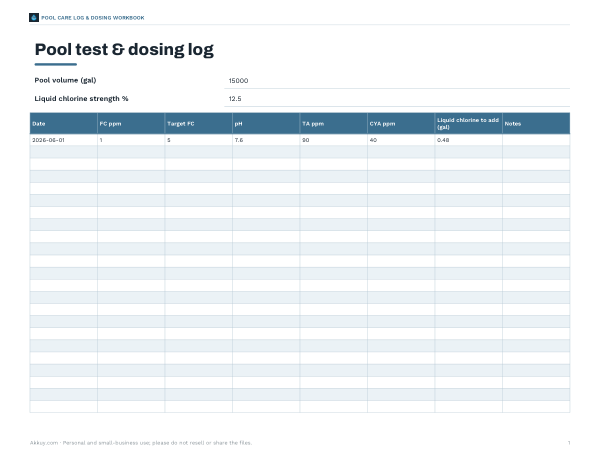
A 15,000-gallon pool has 1 ppm free chlorine and you want 5 ppm. The increase is 4 ppm. With 12.5% liquid chlorine, you need 4 × 15,000 ÷ 10,000 ÷ 12.5 = 0.48 gallons, about 61 fluid ounces. With 65% cal-hypo you would need about 0.77 lb (12 oz) instead, and with dichlor about 0.9 lb — but dichlor would also add about 3.6 ppm of CYA, which builds up over a season.
Choosing a chlorine product
- Liquid chlorine — adds no CYA or calcium, easy to dose precisely; loses strength with age and heat, so buy fresh and store cool.
- Cal-hypo — strong and stores well; adds calcium, which can cause scaling in hard water. Pre-dissolve in a bucket of water as the label directs.
- Dichlor — dissolves quickly, near-neutral pH; adds CYA, useful for new pools that need stabiliser, but CYA accumulates.
- Trichlor tabs — slow-dissolving for floaters and feeders; adds CYA and lowers pH and alkalinity over time.
- Salt chlorine generators — make chlorine from dissolved salt; you still need to test and adjust.
Measuring pool volume
Accurate dosing depends on an accurate volume. For rectangular pools, gallons = length × width × average depth (in feet) × 7.48. For round pools, gallons = diameter² × average depth × 5.9. For oval pools, gallons = length × width × average depth × 5.9. Average depth is (shallow end + deep end) ÷ 2 for a constant slope. If the pool was filled from a metered supply, the water bill may give a better figure.
Adding chlorine safely
- Add chlorine in the evening; sunlight breaks it down quickly.
- Pour liquid chlorine slowly in front of a return jet with the pump running.
- Never mix different chlorine products, or chlorine with acid, in a container — dangerous gases can form. Add them to the pool separately, well apart in time.
- Wear eye protection and gloves, and rinse spills with plenty of water.
- Store chlorine cool, dry and away from acids, fertilisers and fuels.
- Retest after the water has circulated for at least an hour before swimming.
Recommended water balance
| Test | Typical target range (residential) |
|---|---|
| Free chlorine | Depends on CYA; often 3–7 ppm with 30–50 ppm CYA |
| pH | 7.2–7.8 |
| Total alkalinity | 60–120 ppm |
| Calcium hardness (plaster) | 250–450 ppm |
| Cyanuric acid (outdoor, chlorine) | 30–50 ppm; higher for salt pools |
| Combined chlorine | Below 0.5 ppm |
Testing correctly
Test free chlorine with a reliable test kit — FAS-DPD drop tests read high chlorine levels more accurately than many strips, which matters when shocking. Take the sample from about elbow depth, away from return jets and skimmers, and test at the same time of day for consistent readings. Record results so you can see how quickly chlorine drops each day; the daily loss tells you how much to add as a routine and alerts you early to algae, which consumes chlorine rapidly.
Frequently asked questions
How much liquid chlorine per 10,000 gallons?
About 0.08 gallons (10 fl oz) of 12.5% liquid chlorine raises free chlorine by 1 ppm in 10,000 gallons.
Can I use household bleach in a pool?
Plain, unscented bleach works; it is weaker (usually 6–8.25%), so you need more.
What should my free chlorine be?
It depends on CYA. A common guideline is a minimum of about 7.5% of CYA, so 3 ppm at 40 ppm CYA.
How long after adding chlorine can I swim?
Wait until it has circulated and free chlorine has returned to your normal range; follow product labels.
Why does my chlorine disappear overnight?
Losing more than about 1 ppm overnight with no sunlight often indicates algae or another chlorine demand.
Does trichlor raise stabiliser?
Yes, about 0.6 ppm CYA for every 1 ppm of chlorine added.
Is this calculator for public pools?
It gives general guidance. Public and commercial pools must follow local health regulations and product labels.